
What makes good design? Scott James, Head of Technology, reflects on how students learn to create solutions that respond to human needs.
Initially, a student’s understanding of ‘good design’ tends to be simple.
They will ask themselves; ‘Does it perform a function I value?’, and, ‘Do I think it looks good?’.
As students progress, they widen this definition as they realise that everything around them has been designed deliberately, thoughtfully, and in response to real human needs. This leads them to ask better, more objective questions, such as; ‘Who was this made for?’, ‘What problem is it solving?’, ‘Why does it function this way?’, and ‘Could it serve that purpose and those end users’ needs better?’.
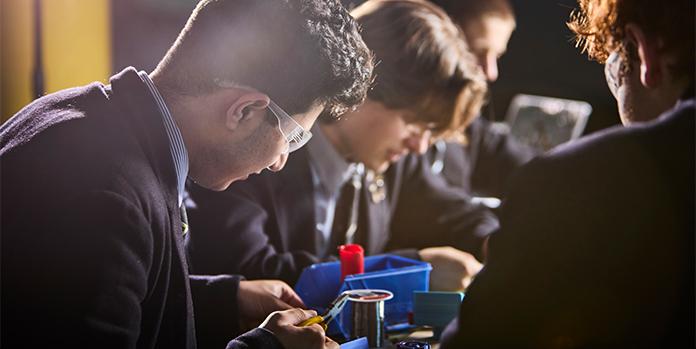
A good Design and Technology classroom will typically have a bit of a buzz around it. From students sketching ideas, to prototypes being scattered across a table, a laser cutter finishing its final pass, or machines humming in the workshop; this what most students expect and hope for from Technology Faculty subjects.
Beyond that though, students learn to see the world like true designers, which is paramount at the VCE level, particularly so if they want to pursue a design profession as a career. To boil it down to its most simple mandate: designing is problem solving, and often, you will be solving problems for people other than yourself. To really do that well, you need to work to deeply understand the needs of others and be able put yourself in their shoes.
We are lucky at Melbourne Grammar School. Our school and community aim to nurture students who are empathetic and considerate of others. It is a key part of our wider curriculum, and that helps us foster young designers who can consider solutions beyond themselves.
Our Designing for Others unit is often the first time that students truly understand that good design begins by considering the end user’s experience. Last year, we collaborated with a company whose aim is to improve the experience of those with disabilities when they are travelling through Melbourne. We took students to Southern Cross Station, where they experienced what it was like to navigate the platforms without the ease they were accustomed to. Wearing vision-inhibiting glasses, they needed to rely on handrails, walking canes, and the tactile flooring on the ground of the platforms. Our modern human world is largely made up of designed items, and through experiences like this, students grow to understand just how difficult it can be to interact with this world if those designed solutions aren’t inclusive for everyone.
Design is an iterative process which often requires regimentation, rather than waiting for inspiration to ‘hit’. It is often difficult, messy, and time consuming, but ultimately, fulfilling. Ideally, students learn to experiment, reflect, refine, and try again. This reassures them that the first idea doesn’t need to be perfect, and they begin to trust the process and take risks.It is less about producing something perfect at first attempt, and more about exploring what’s possible to then refine an idea to a successful solution.
Ultimately, our aim is to help students understand that design is everywhere, but that good design best serves the end user, even if the end user doesn’t have much in common with themselves.
If they can learn to see the world like a designer, they discover that the world isn’t fixed, and that they can solve the problems that exist within it.
Scott James
Head of Technology
Related topics