
Greg Milholland
Last updated: April 2026
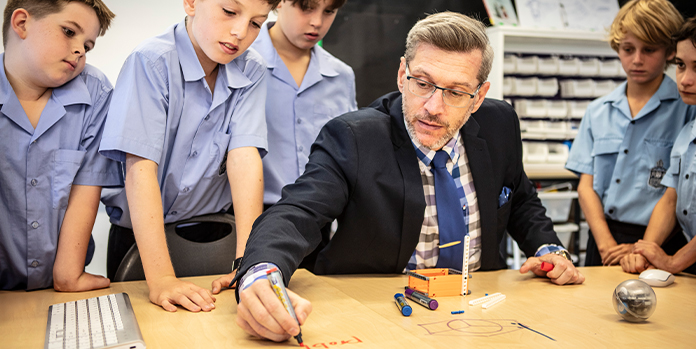
As Head of Digital Learning Technology at Grimwade House, Greg Milholland is as interested in his students’ mistakes as he is in their successes.
“One of the most challenging things to teach younger students is that they don’t have to get something right straightaway,” he says.
“It’s so important for us to teach students that getting to success is a process. That’s what design thinking teaches us.”
Design thinking – an iterative approach to problem-solving – is embedded across the Melbourne Grammar School curriculum, beginning in Junior Primary.
In Years 2 and 3, the goal is to create a sense of curiosity.
“Even through tools as simple as picture books, we’re finding ways to encourage students to use iterative thinking processes to solve problems. We’re teaching them that they will encounter sticking points, and that they won’t also be able to solve every puzzle immediately.”
But, Mr Milholland says, that doesn’t have to be a bad thing.
“Working out a design challenge means we have to face our own mistakes, and listen to others to learn how to improve,” he says.
“Students have to justify their reasoning, back up their arguments, and think outside their own perspectives.”
Mr Milholland’s experience includes leadership roles across Victorian schools along with time at an international school in Shenzhen, China.
He holds qualifications from the Harvard Graduate School of Education and the University of Melbourne, as well as an award for Primary School Teacher of the Year in the 2025 Australian Education Awards.
In his role today, he aims to give students confidence using digital technology early, so they can continue using it to solve problems throughout their education and beyond.
“By having early experiences in coding, robotics, and electrical engineering, Grimwade students are more excited to take advantage of what they already know when they reach Senior School,” Mr Milholland says.
“We’re introducing some of those higher-level skills earlier, because students are more than capable of learning them at that younger age.”
By the time they reach Upper Primary, students are confidently using tools such CAD, coding languages, and 3D printers.
“All of these tools present challenges, and none of them are challenges we can solve in a single step,” he says.
“When they don’t succeed, the question they have to ask themselves is always the same: How do we make it better?”
Part of this includes encouraging students to respond to the world around them – and empowering them to use design thinking to improve it. Last year, Year 6 students created a system where a light flashes to show that someone is coming around a corner, so they don’t collide with someone coming the other way.
Alongside real-world applications, students also engage in more playful projects that encourage iterative thinking in different ways – such as making ‘battle bots’ that search for and knock the flag off their opponents.
“Eventually, I see students walk out of the classroom with a new attitude: They know how to ask for feedback, and to take on board what they hear so they can make their work, and the world, better.”