
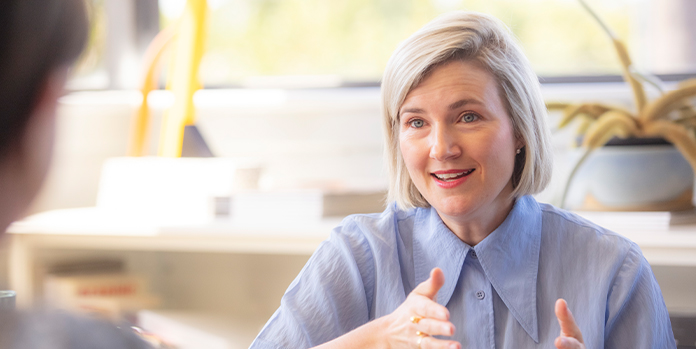
Alex Hopkins (OM 2002)
This article was published in April 2026.
Interior architect Alex Hopkins (OM 2002) understands both the power of good design, and the power of design for good.
As the founder and director of Melbourne-based interior architecture firm Studio Tate, Alex takes pride in creating spaces with impact.
“A number of years ago, we had the opportunity to work on interiors for Jean Hailes for Women’s Health,” she says.
“All of a sudden, our eyes were opened to organisations who are really acting as the backbone of our communities, but don’t have a lot of money to spend on design consultancy fees. We started to ask ourselves: How can we use our design skills to give back to organisations like these?”
The Jean Hailes project became a catalyst for Studio Tate. Alex decided to dedicate part of the business to what she terms ‘Social Impact’ projects, providing interior architecture services to not-for-profit organisations on a pro bono and low bono basis.
Through this model, Studio Tate has transformed interior spaces for organisations across the not-for-profit sector including Indigenous-led organisations, the Centre Against Sexual Assault, and The Living Room, which provides free healthcare and support to those at risk of or experiencing homelessness.
“To know that you’re working on a project that really is making a difference to those who normally wouldn’t be able to access our services – I think that’s pretty special,” Alex says.
Interior architecture focuses on the functionality, structure, design, and space-planning of interior spaces. Alex’s ‘business as usual’ includes a portfolio of clients that she categorises into ‘live’ (residential), ‘work’ (workplace, retail, education) and ‘play’ (wellness, hotel, hospitality).
However, Alex says that the practice is ultimately people-centred, placing equal emphasis on the design team and the end users of each space.
“I have strong creative skills, but I think I also have strengths in terms of my ability to connect with people, to listen, and to get to the crux of what someone’s objective is on a project – perhaps even before they’ve really landed on it themselves.”
Alex’s career path, and the experiences she’s had along the way, have undeniably shaped the way she approaches not only her work, but
her leadership.
“I was really fortunate to have been given opportunities as a young designer, and I want to provide those same opportunities to the people who work with me today,” she says.
“It was a really deliberate decision for me that we create a space where everyone can contribute to the design story.”
Alex reflects on her time at Grimwade House as an important part of her educational foundation that ultimately helped to shape the person she is today.
“Attending Grimwade, you are encouraged to ‘try it’, ‘build it’, and create opportunities,” she says.
“There is encouragement for success and there is a framework to support it if you want to grab it.
“When you’re at a school that provides opportunities for a far-reaching education, you’re given the chance to discover where your true passions lie, and to excel in those areas.”